



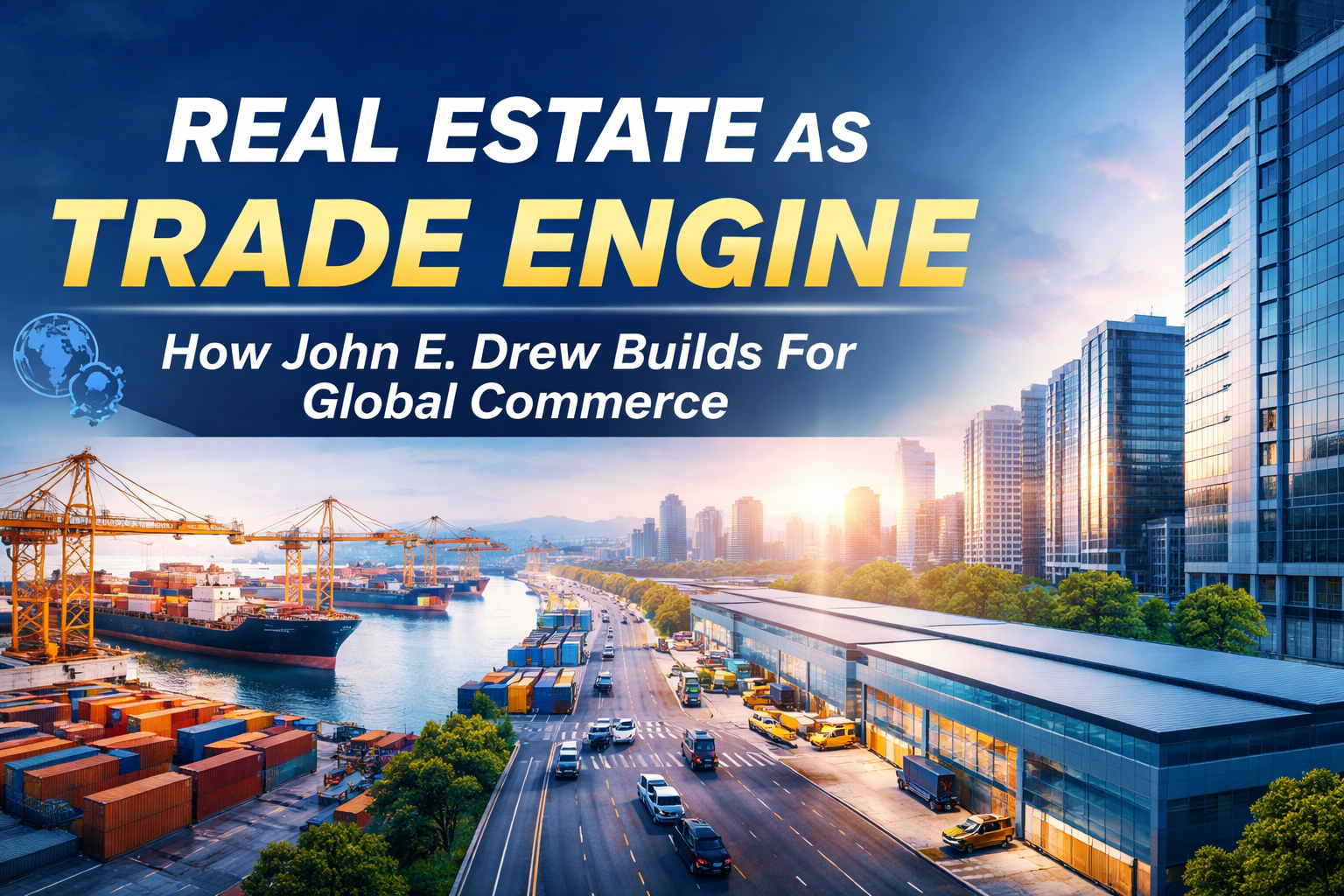
In today’s fast-moving world, real estate is no longer just about buildings. It is about trade, logistics, connectivity, and global growth. Smart developers understand that warehouses, ports, office parks, and mixed-use developments can directly power international commerce.
One such visionary is John E. Drew, who believes real estate is not only about land — it is about creating infrastructure that supports global business. His approach shows how property development can act as a true trade engine for economies.
In this article, we will explore how real estate drives global commerce and how John E. Drew’s strategy reflects modern economic trends.
🌍 Real Estate: The Backbone of Global Commerce
Global trade depends on three main things:
- Infrastructure
- Connectivity
- Strategic location
Real estate connects all three.
Ports need warehouses.
Manufacturers need industrial parks.
Tech companies need smart office spaces.
Retail businesses need distribution centers.
Without strong real estate planning, global trade slows down.
John E. Drew understands this connection deeply. Instead of building random properties, he focuses on strategic developments that improve trade flow, business efficiency, and long-term economic growth.
📦 Strategic Location: The First Rule of Trade-Driven Development
One of the key principles in trade-focused real estate is location intelligence.
Properties located near:
- Airports
- Seaports
- Highways
- Business corridors
Have higher commercial value.
John E. Drew emphasizes selecting areas that connect directly to global supply chains. For example:
- Logistics hubs near transport routes
- Commercial spaces near financial districts
- Industrial developments near shipping terminals
This strategy reduces transportation costs and increases speed — two major factors in international commerce.
When businesses save time and money, they grow faster. That growth boosts the entire economy.
🏗 Building Infrastructure That Attracts Global Companies
Modern global companies look for more than just space. They look for:
- Energy-efficient buildings
- Smart infrastructure
- Advanced logistics systems
- Flexible office layouts
John E. Drew’s projects focus on creating future-ready infrastructure.
For example:
- Warehouses designed for automation
- Offices built for hybrid work
- Mixed-use projects combining retail, residential, and business
This model supports long-term commerce instead of short-term profits.
🌎 Real Estate as an Economic Multiplier
When a major commercial project is developed, it creates impact in multiple layers:
- Construction jobs
- Local supplier contracts
- Business relocation opportunities
- Increased property value
- Tax revenue growth
This is why real estate is called an economic multiplier.
John E. Drew’s approach focuses on developments that encourage:
- International companies to enter new markets
- Regional businesses to expand
- Investors to see long-term stability
Strong commercial real estate increases investor confidence. And investor confidence drives trade.
💼 Creating Business Ecosystems, Not Just Buildings
Modern trade requires collaboration.
Instead of isolated office towers, the future lies in business ecosystems:
- Industrial clusters
- Innovation parks
- Logistics corridors
- Mixed-use trade districts
John E. Drew supports developments that combine:
- Office space
- Warehousing
- Retail centers
- Residential options
This reduces commuting, improves productivity, and strengthens trade networks.
Companies prefer locations where suppliers, partners, and customers are nearby. Real estate can create that advantage.
🚢 Supporting Global Supply Chains
Global supply chains depend on speed and reliability.
Recent global disruptions have shown that countries with strong logistics infrastructure recover faster. Real estate developers who focus on:
- Distribution centers
- Cold storage facilities
- Port-connected warehouses
Directly strengthen global trade resilience.
John E. Drew’s philosophy reflects this trend — build properties that reduce supply chain risks and improve movement efficiency.
🌱 Sustainable Development for Long-Term Trade Growth
Today, global commerce must balance growth with sustainability.
Green buildings reduce:
- Energy costs
- Carbon footprint
- Operational expenses
Many global companies prefer sustainable real estate because it aligns with ESG (Environmental, Social, Governance) standards.
Trade-driven real estate must now include:
- Solar-ready rooftops
- Energy-efficient materials
- Smart energy systems
Developers like John E. Drew understand that sustainable infrastructure attracts international investors and global brands.
📈 Investment Strategy: Real Estate as a Global Asset
Commercial real estate connected to trade corridors offers:
- Stable rental income
- High long-term appreciation
- Strong tenant demand
International investors look for properties that support:
- Logistics
- Manufacturing
- Technology
- Global retail
By building for commerce, John E. Drew positions projects as global investment assets — not just local developments.
🏙 Urban Growth and International Expansion
As cities expand, trade corridors become more valuable.
Strategic developments:
- Improve transportation networks
- Increase international trade flow
- Create new business districts
Real estate becomes a foundation for:
- Export growth
- Import efficiency
- Global partnerships
John E. Drew’s vision reflects the modern idea that cities are global trade platforms.
🔎 Why Real Estate is the True Trade Engine
Real estate impacts:
- Where businesses operate
- How goods move
- How fast markets grow
- How investors invest
Without modern logistics parks, industrial hubs, and commercial corridors, global commerce cannot function smoothly.
John E. Drew’s development philosophy highlights that the future of trade is not just digital — it is also physical infrastructure.
Buildings shape economies.
Conclusion
Real estate is no longer passive. It is active economic infrastructure.
Through strategic location selection, modern infrastructure design, sustainable practices, and supply chain support, developers like John E. Drew show how property development can power global commerce.
In today’s world, real estate is not just land — it is a trade engine driving international growth, business expansion, and economic resilience.
As global commerce becomes more interconnected, smart real estate development will continue to shape the future of trade.
Frequently Asked Questions (FAQs)
1. How does real estate support global trade?
Real estate provides infrastructure such as warehouses, ports, offices, and logistics centers that enable businesses to operate and move goods efficiently.
2. Why is location important in trade-focused development?
Location near transport hubs reduces costs, improves delivery speed, and increases business efficiency.
3. What makes real estate an economic multiplier?
Commercial developments create jobs, increase tax revenue, attract investors, and stimulate local business growth.
4. How does sustainable real estate benefit global companies?
Energy-efficient buildings reduce operating costs and align with ESG standards, making them attractive to international firms.
5. Why is logistics infrastructure important for commerce?
Strong logistics infrastructure ensures faster shipping, supply chain stability, and smoother international trade operations.


